You can only drive your car properly when you can see where you are going. If you don’t have clear visibility, you will end up in a ditch before you get very far.
The same applies to a business. But most business information is historical, equivalent to driving forward whilst looking out of the rear windscreen.
In this post, we will show you how to find ways of looking out of the front windscreen. We will identify forward-looking Key Performance Indicators (KPIs) that can help you make sure that you drive safely down the road to your Envisioned Future.
Identifying your KPIs
Imagine that you are marooned on a desert island.
In between lying in the sun and drinking Lilt, you are concerned about how your business is faring in your absence. Luckily, you are able to receive a carrier seagull each week, which can bring you 12 pieces of information about your business.
What would you want to know that would help you assess the health of the business today and its prospects for the future?
When you’re thinking about this, don’t worry about what you can and can’t measure currently. Think abotu what you want and need to know, and find a way to measure it later.
Think about the 5 axes along which we split the business when we were creating our Envisioned Future, of Customer, Products, People, Operations and Financials. Think about the key elements of your strategy. If new product launches are important, find a measure for that.
Try to find forward-looking measures, sometimes known as lead indicators.
As an example, let’s look at sales, the lifeblood of any business. A backwards-looking lag indicator is your sales last month. A forward-looking lead indicator might be your forecast sales for the month or the year, or a measure of your sales pipeline. A nice measure of a pipeline is the Pipeline Index, defined as:
The Pipeline index is a single number, which on its own doesn’t mean a lot. But the higher the number, the more sales you are likely to win in the future. Try creating your own indices: if you are a retail business, the Pipeline index doesn’t apply. But what actually drives your sales? It could be a combination of Google Ads spend plus social media posts plus seasonality. Analysis of historic data could show some patterns.
You will probably identify many more than a dozen potential KPIs, but be ruthless and winnow them down to 12. Some information is likely to be a PI rather than a KPI.
Using your KPIs
Your KPIs will tell you about the health of your business, so you will need to monitor them regularly, ideally weekly. We’ll come back to meeting schedules in a couple of posts’ time. When you look at KPIs, the trend is the key thing to watch. If you can see your pipeline index declining, you will want to take action before it impacts sales. You might want to set targets and limits for each KPI. But remember that the whole point of having KPIs is to allow you to take action. To continue our (now slightly strained) car analogy, if you can see that you’re veering off the road, you need to turn the wheel or apply the brakes, otherwise you will crash.
We will talk in a later post about how to track actions to ensure that they get done.
Financial information
Having clear timely financial information allows you and your management team to run the business efficiently, and gives you an insight into what is actually happening. Unfortunately, most financial information is neither clear nor timely, and the accounting profession can sometimes be more problem than solution.
As a leader of a business, the management accounts (as opposed to the statutory accounts that go annually to Companies House) are yours, not the CFO’s. They are a key business tool. The CFO has spent many years training to be an accountant, learning all the standards and rules, and prizes accuracy and adherence to accounting rules when creating accounts. You prize speed and usefulness – hence the potential for conflict, and why you need to own them.
There are many ways of setting out management accounts, and you need to make sure that they are useful in driving the right behaviours and for making decisions. As an example, accountants often recognise unbilled work done on contracts that are longer than a month as turnover (often called WIP or work in progress). This makes sales and profit look good, but removes the incentive to raise an invoice and get the cash in sooner. Exclude WIP from monthly accounts, and push your commercial team to invoice earlier. It also makes accounts simpler and therefore quicker to produce.
Make sure that your (management) accounts work for your business and help you achieve your Envisioned Future. Some key areas to consider:
Creating the right management accounts for your business
Are there operating units within the business that should have their own P&Ls? How far down should you take the P&L? (From a behaviour point of view, nothing motivates quite like a negative number at the bottom of a page, so look to allocate more cost rather than less to each business unit to create a true measure of profit.)
What’s the best way to show sales? Should you split sales by strategic areas? How do you show internal revenue? Which sources of income should you show elsewhere (eg rent from a spare building)? Should you account for WIP?
What should you include within cost of sales? What should you show as an expense? How can you make your gross margin % useful?
Do you have a standard costing system? Does anyone understand it? Does it make your numbers easier or harder to understand? (We can answer that one for you – harder.) Consider not using it for your monthly accounts.
Is there transfer pricing in place? Multinationals are keen to recognise tax in the countries with the lowest rates, so play games with pricing. This can have a big impact on decision making, especially if you don’t actually know which of your products are profitable.
What terminology should you use? Use words that people understand.
Is the balance sheet being used to massage the P&L numbers? Find out how.
It can be easy to be brow-beaten by a CFO that knows more about accounts than you. Following these principles can help:
Look to simplify accounts rather than complicate. All managers need to understand the accounts, especially budget holders.
If there is a conflict between accounting rules and usefulness, usefulness wins.
Label items in clear English, and have an explanation of terms attached to your accounts
Last time, we discussed how to identify the key skills needed in each area. The best CFOs understand all of this, and will help you make sense of your business. They can also train your team in how to read accounts.
Most businesses publish accounts 3 or 4 (or more) weeks after the month end. This is not very useful. They do this because it gives the finance team time to receive all the invoices and expenses relating to the month (it helps with accuracy). But in most businesses, the key numbers are known or can be accurately estimated much earlier. Discuss with your finance people where you are happy to sacrifice accuracy for speed. Set deadlines that suit you to receive the information. Is there financial information that you could receive daily or weekly?
Lastly, proactively manage your monthly accounts. In your weekly meetings (more on that soon), ask the relevant people to predict sales and costs for the month. This avoids nasty surprises, gives you time to take action if needed, and gets your team used to how the numbers work.
Conclusion
Armed with the right information, you will find that you have a much better understanding of how your business is really performing, and you will make better and earlier decisions. You will be driving whilst looking out the front windscreen, able to see risks and opportunities before you hit them. What wins have you had from making the right information available? Let us know!
Next time, we will look at how to ensure that your business processes are fit for purpose.
igesia Consulting helps businesses and the people in them to become peak performing. We understand what the very best organisations do, and work with companies like yours to give you the skills, plans and structures to do the same.
People are the lifeblood of a business. If you have great people who know exactly what they are doing, then the best thing you can do is let them get on with it. But if your business is changing, your people will have to change too. You will need new skills and behaviours and perhaps attitudes to deliver your Vision. This is why People occupy such a prominent position in our strategic Framework.
In our last few posts (starting here), we showed you how you could build a great strategy. But you will only deliver it by getting the people element right. Having a clear strategy allows you to better predict what skills you will need in the future, and to make sure that you have them when you need them.
There are two ways you can ensure you have the right skills in the right place at the right time. You can either train and develop your existing people, or you can recruit them from elsewhere. There are pros and cons of both, but your goal should always be to find the best person. We’ll come back to this in the future. But first, we’ll think about how to identify the skills you might need.
Identifying the right skills
The tool that we use to identify skills is called an Accountability Chart. It’s like a standard organisational structure, but on steroids – it also sets out what each role is responsible for and the key skills required to do it. Here’s how you create them.
In keeping with how you built the strategy, you start from the end and work back. Work out a structure for your Envisioned Future first. It should include job names but no individual names: you want to create the right structure without being constrained by who’s in those roles currently. A few pointers:
Start with a clean sheet of paper and forget what you have now.
Draw out the key functions first, and then add the responsibilities and skills when you’re happy with the overall structure.
There are three core functions in a business: Finance, Sales and Operations. Make sure that they are included.
Reflect the key parts of your strategy. If innovation is important, consider having a Head of Innovation. If your sales team will be split by product line rather than account, does your sales structure reflect that? What roles don’t exist but are important to your Vision?
Drill down as many levels as is useful in the context of your strategy; generally this is at least three levels down (eg CEO – Sales Director – Field Sales Force Manager), but in key areas you may want to go deeper. Mckinsey research suggests 60% of the most value-creating roles are two levels below the CEO.
Put roles at the level which you think makes sense, not where they are now.
How many people will be required in each department? Which areas will need to become more efficient and which will need investment?
Think about span of control – how many roles report into any given individual? More than six becomes difficult to manage.
When you have a structure that you are happy with, create a structure at each BHAG, rolling back from the end. How quickly can you get to where you need to? What are the constraints? When can you afford the structure you want? It can be a good idea to highlight what changes from one time point to the next.
At each time point, outline the key responsibilities for each role. Use your documented EF and BHAGs – who would own and deliver each area?
Next, think about the 5 key skills that each role would need to be successful and that are specific to it. For instance, all managers will need to be good at managing people and controlling budgets; you can take that as a given (but don’t ignore for your position contracts – see later). This may mean asking questions that you hadn’t considered earlier in the process. Where will your sales team find their leads? What methodologies will drive a 50% improvement in processing costs? Will we need in house data analytics? Answering these kinds of questions takes your thinking deeper and deeper, showing the rigour that this framework encourages. Just make sure you document it all!
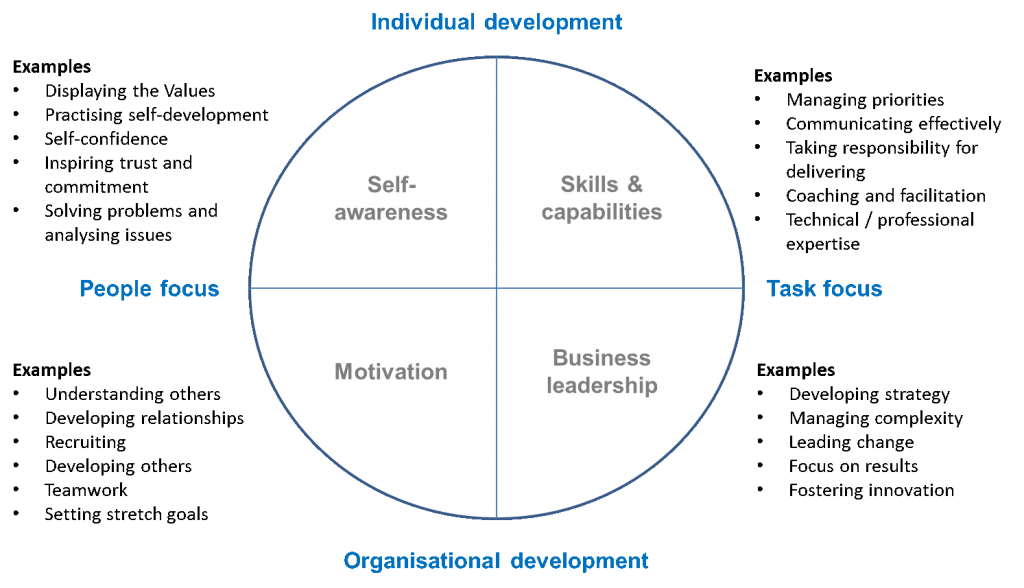
Skills tend to fall into one of the four quadrants below. Make sure you have covered all of them in your thinking, though not every role needs to have skills from every area.
As an aside, this 5 competencies tool is very useful for quick but accurate assessments of current employees. As a manager, it can be hard to objectively assess the suitability of your reports for the role. Building trust and a true personal relationship gets the best out of people, but can get you too close to be clear-eyed about their performance. This tool can square that circle.
Score them out of 10; we don’t allow 7s… It can help to think of the scoring in terms of football. A 10 would make the national team; 8s and 9’s are paid professionals. A 6 would be a good Sunday league amateur player. 4s and 5s can kick a ball about without embarrassing themselves. A 1 can’t even kick a ball without falling over.
Benefits of an accountability chart
Now you have a really good idea of how you will structure your business, and the kinds of skills you will need. As with much of our framework, by doing this thinking you might immediately start to change what you do in some key areas:
You may realise that you need to make changes to your structure immediately. Structures tend to evolve over time, and can easily pass their sell by date. What actions should you take now?
You will find yourself more forward-thinking in your recruiting, identifying people who can contribute to your business tomorrow as well as today.
You will be able to have much better career conversations with your people. You will be able to show them how opportunities will arise in the future, which can be great for motivation and retention, as well as showing how they will need to develop their skills.
But the real power of this thinking is when we start to combine it with other tools and techniques (such as your performance management system, situational leadership and position contracts) in our overall framework, which we will come back to in future posts.
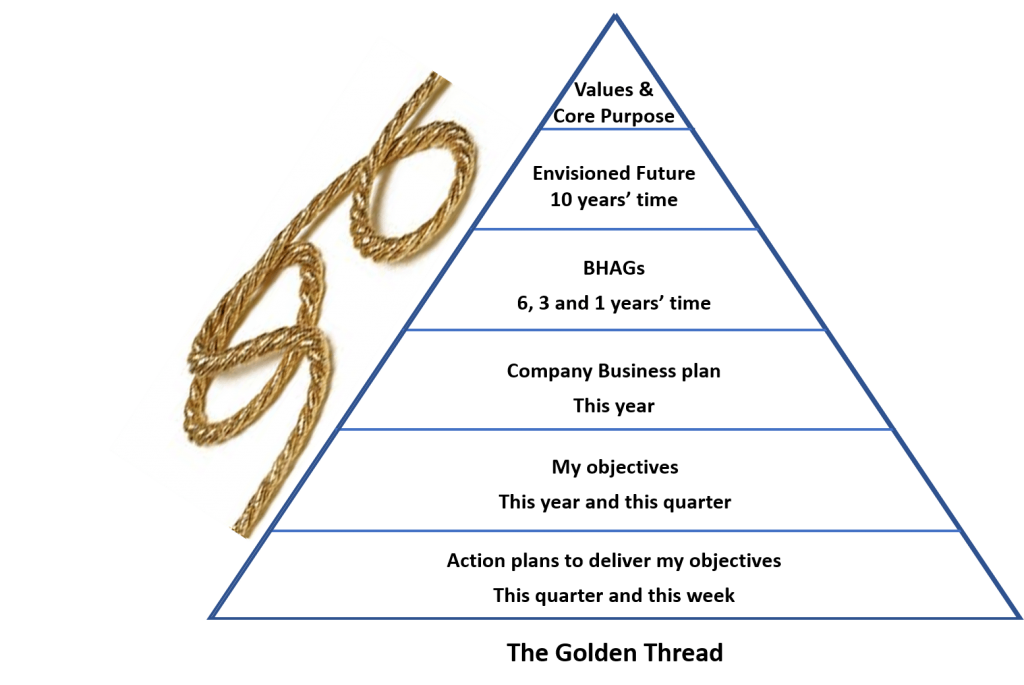
But to finish on, let’s remind ourselves why we are thinking about people here. Our real goal is to ensure that the actions of our employees today help to deliver our Vision for the business in 10 years’ time. We call this linkage the Golden Thread, the line of sight that connects company strategy through to individual action. We’ll come back to it in future posts. You could argue that creating all the elements of the Golden Thread is the only unique skill required for the CEO role. That should inspire some comments – let us know if you agree or disagree!
Next time, we’ll be thinking about how we know if our business is on track.
igesia Consulting helps businesses and the people in them to become peak performing. We understand what the very best organisations do, and work with companies like yours to give you the skills, plans and structures to do the same.
“Now, here, you see, it takes all the running you can do, to keep in the same place. If you want to get somewhere else, you must run at least twice as fast as that!”
The Red Queen from Alice in Wonderland, Lewis Carroll
Introduction
In our last two posts, we have discussed how to create and execute a strategic Vision, consisting of Purpose, Values and Envisioned Future and BHAGs. We haven’t dived into the detail of how to create a truly winning strategic positioning. Now’s the time to do that….
How and where we compete is the central part of any strategy, and should be the main thing that keeps CEOs awake at night. The right strategic positioning opens up worlds of opportunity – and profit – but getting it wrong can cost money, jobs or even our business survival.
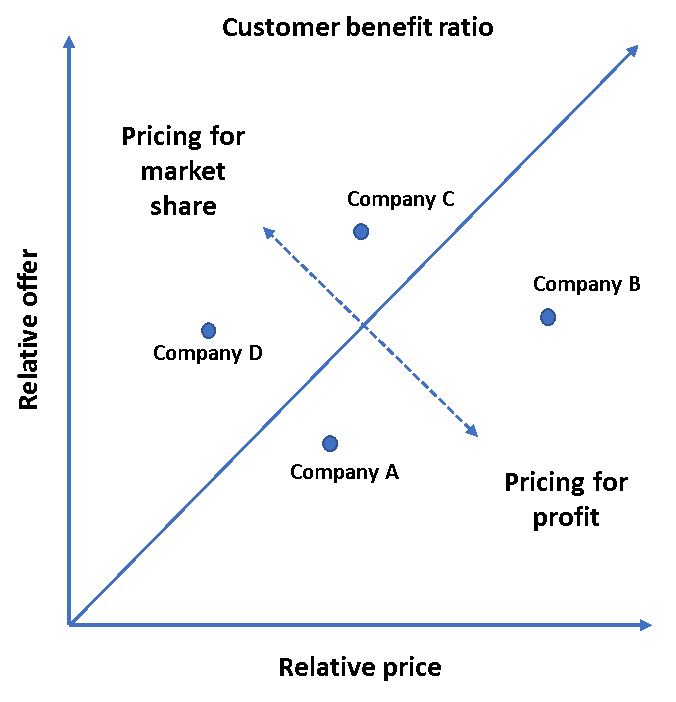
Let’s think first about a traditional mature industry. Competitors have an offer, consisting of a whole suite of different features, and they decide how to price it, often with reference to the wider market. You can plot businesses in these industries onto what is known as a customer benefit ratio:
The diagonal line is where offer and price (relative to the market) are in balance, and you will achieve market average growth. If you fall above and to the left of the diagonal, you are under-pricing your offer; you will grow sales and market share. To the right and below, you are over-pricing and will make more profit, but perhaps only in the short-term.
The graph suggests companies have a choice between sales growth or profit. The degree to which above-average sales growth and profit are incompatible depends on the industry; very much so in, for example, consumer financial products, less so in luxury goods. And pricing for share can also drive profit in industries with high fixed costs such as supermarkets. But there is always a trade-off, placing a cap on the profits that can be earned.
The most profitable companies are ones that are unconstrained by competition. In the last post, we identified that there are only a few ways to compete:
The most profitable companies (measured by return on capital) are often The Only companies. Aramco has exclusive access to Saudi Arabia’s vast oil reserves. Apple sets itself apart from other consumer electronics companies through the strength of its brand, not its technology. In this post, we will think about how to deliberately create a positioning which helps to make our competition irrelevant.
Strategic winners are often the businesses that open up new – and uncontested – market space, creating a leap in value for their customers. We see this as the cornerstone of high performance. Here’s an example.
(yellow tail) – disruptive transformation
At the turn of the last millennium, Casella, an Australian wine producer, wanted to make an impact in the American wine industry. Casella saw that existing competitors were playing the customer benefit ratio game, and they realised they couldn’t play by the existing rules if they wanted to really win. The incumbents were seeking to compete on quality by adding complex layers of flavours, trying to win awards in wine competitions. But when everyone tries to compete in the same way, their relative positions don’t move – so they were adding cost to their products, but not driving sales.
Casella added a consumer insight to their industry understanding: they realised that most consumers found this game pretentious and intimidating, and chose to drink other tipples instead. As a result, wine was under-performing in the market for alcoholic drinks.
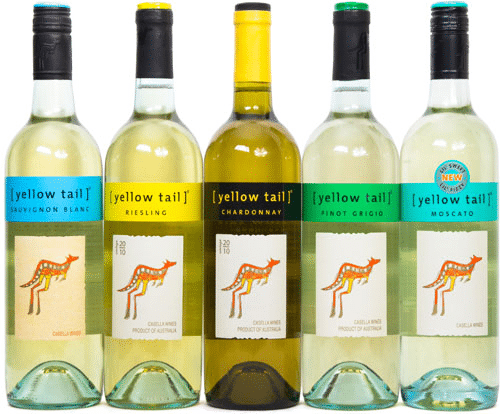
Casella positioned their wine as a fun simple social drink and called it (yellow tail). This was embodied in the branding (an Aboriginal style kangaroo, no capitals and superfluous brackets), and Casella reinforced it with striking instore displays.
The results were spectacular. In two years, (yellow tail) became the fastest growing wine in both Australia and the USA, and the number one red wine in the US, outcompeting its Californian rivals. And in an industry were players were struggling to make a profit, Casella was making 30% bottom line on sales of $255m after just 5 years.
The strategy canvas
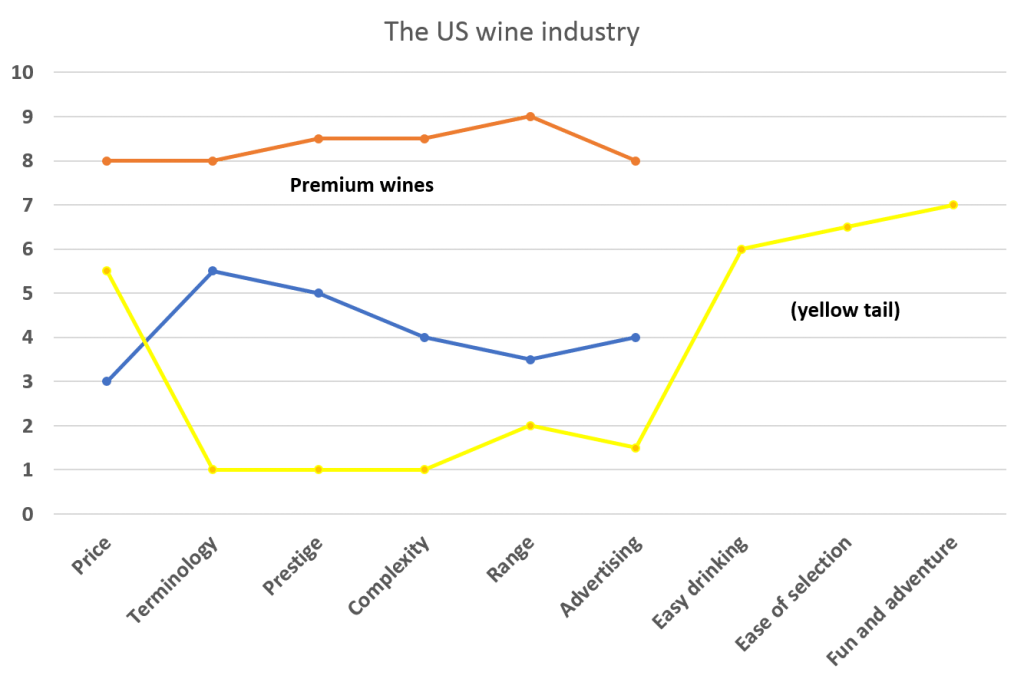
A strategy canvas is both a diagnostic and an action framework to allow you to build a compelling uncontested market space strategy. It captures the current state of play in the industry, looks at how competitors are addressing the market, and then allows you to change how you want to compete. It helps to explain why (yellow tail) succeeded.
Here’s how to use it:
1. Identify the factors of competition
What are the factors that the market competes on currently in your industry? This is the diagnostic element.
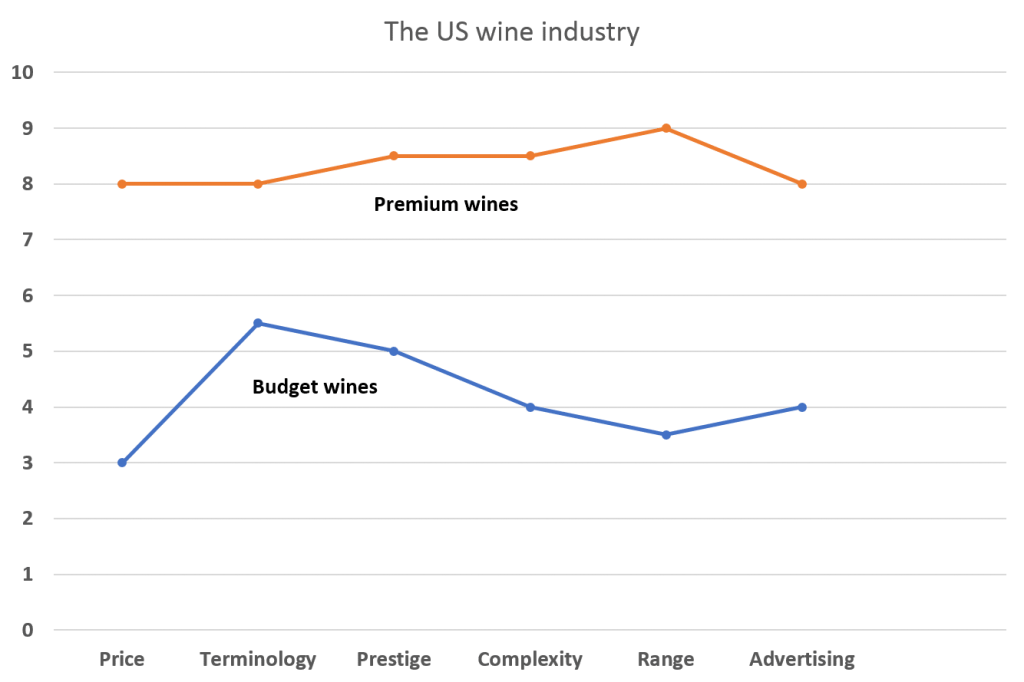
For the US wine industry (pre-(yellow tail)), this included:
Price per bottle
Packaging rich with obscure wine terminology
Prestige of the vineyard and its legacy
Complexity of flavour
A diverse range to cover all grape varieties
Consumer advertising to influence shoppers and industry buyers
We can plot it something like this, splitting the market into two broad categories of budget and premium wines:
For your own industry, be as exhaustive as you can on the number of factors. Plot individual competitors, not just the industry average. How unique is your offer?
2. Do your research
It’s no coincidence that Casella was an outsider to the US wine industry. Outsiders are always more willing to tear up the old rules. The best businesses are able to continually think as outsiders, and can reimagine what their business could be, over and over again.
There are many ways to help you think like an outsider. You could:
Look at what the best businesses outside your industry do.
Imagine what Amazon / Apple / Disney / the All Blacks would do if they were to enter your industry.
Understand what your customers really think about your product. What are they doing with it? How do they use it? What frustrates them about it? About you?
Speak to / survey people who could or should be customers of your industry and aren’t. Try to find out why they’re not a customer. This is where Casella gained its insight – it didn’t grow sales by stealing from other wine brands; it stole from drinkers of other social alcoholic drinks, such as maybe Babycham.
Think about how technology could allow your industry to work differently.
What are substitute products to yours? What can you learn from them?
If you don’t understand the importance of each factor with customers, carry out some market research. It can be useful to split this between your customers, customers of competitors and potential customers. Which factors matter most and least to your target customer?
3. Decide what to change
Take the factors of competition that you identified in step 1 and decide whether to:
a. Reduce;
b. Eliminate;
c. Increase; or
d. Create new ones.
It pays to be brave here. Eliminating and reducing is great for your cost base, and ensures you don’t over-design products or services . The budget airline industry (Southwest Airlines in the US, its devotee Ryanair in Europe) is willing to sacrifice just about everything on the altar of price. Ryanair deliberately releases rumours of standing ‘seats’ or charging for use of the restrooms to underline this point.
But creating new factors is where you can really create new demand at the same time as strategically shifting your price points. Casella reduced a range of factors, but added three new low-cost factors, which in turn allowed it to raise prices. That’s right – it had a lower cost structure but could charge higher prices. Anyone interested?
When you are doing this, plot where you are now, and where you would like to be. These become key strategic actions for you, and should be reflected in your Envisioned Future and BHAGs.
4. Make the changes
Over the next few posts, we will show you how to make your vision become a reality.
5. Repeat
We encourage everyone to have an annual strategy development cycle. If what you are doing is working, others will copy it. We started this blog with the Red Queen’s quote from Alice in Wonderland. We need to run twice as fast as everyone else to win and keep winning. (yellow tail) spawned a host of competitors; you can’t stand still.
Characteristics of a good strategy
When you are developing your positioning, check it meets these three characteristics:
a. Focus. Are you trying to compete on every factor, or are you clear about exactly what you will compete on?
b. Divergence. Is your line on the strategy canvas clearly different to everyone else’s? A feature of reactive businesses is that they tend to have very similar lines; that’s why we could plot the wine industry as a whole.
c. A compelling tagline. Can you summarise your plan in a simple punchy statement that your customers and your people will remember. Southwest Airlines say: “The speed of a plane at the price of a car, whenever you need it”.
New technology means that entirely new business models can be created in almost any industry. Just look at the current retail market: the number of empty stores and retail bankruptcies show just how much impact online shopping is having on traditional businesses. New marketing approaches (Kylie Jenner, for example) can also disrupt industries.
If you’re not thinking like this, one of your competitors or a start-up that you’ve never heard of in some trendy area of town will be. Even if you’re not able to open up a massive untapped market, this approach will allow you to create enough differentiation to keep moving your pricing upwards without having to sacrifice market share.
Next post, we will start thinking about the skills and structures we will need to deliver our strategy. In the meantime, tell us what you think about strategy canvases, or other ways that you have been able to create a winning market position.
igesia Consulting helps businesses and the people in them to become peak performing. We understand what the very best organisations do, and work with companies like yours to give you the skills, plans and structures to do the same.
Last time, we started looking at what a Vision was for a business, and how to build your own. To recap, it consists of the 4 core components of a Core Purpose, Values, an Envisioned Future and the BHAGs. We talked about how to create your Core Purpose and Values. In this post, we will examine how to build your Envisioned Future. You can think of it like this:
A quick word first. Many people have written about strategy and have strong views on what it is and what it isn’t. We are presenting one approach, an approach that has worked many times in real life practical situations. But if you have a different – perhaps better – one, by all means use it (and please tell us about it!). Just don’t lose sight of the bigger picture – that your strategy needs to work within your business. Remember the strategic Framework that we discussed.
We also get challenged about how we can create a Vision for 10 years’ time, when the world is changing so fast and there is so much that we can’t possibly predict or know. It’s a fair challenge, and there are a number of ways of answering it:
Is your industry immune from a disruptor? Management books are littered with case studies of big companies that didn’t think so: Kodak (inventor of the digital camera), Blockbuster (were offered Netflix twice and chose not to buy it), Thomas Cook… Will you be the disruptor or the disrupted?
It is true that the Visioning approach works best for more predictable industries. We will discuss in a future post other strategic approaches for more unpredictable industries. But visioning remains a core element in all of them, and is a skill well worth having.
This isn’t about predicting the future. There will be lots we can’t predict, but that’s not the point – we are trying to create our own future, not react to other people’s. We revisit the strategy annually to build in changes we see coming. And we need to have the ability to react and adapt to sudden changes that we didn’t see.
This post guides you through the process of creating a strategy for an operating company, at the level of a coherent business unit. If you have more than one business, they will probably need different strategies. A Group strategy is somewhat different, and is about resource allocation – where to invest, divest, acquire.
Creating your Envisioned Future
A great EF consists of a short but compelling statement of how the business will look in 5 or 10 years’ time, accompanied by a detailed exploration of what that means across the key parts of the business. By describing it, you help make it become reality.
Here’s a step by step guide to building your own, ideally with the senior team in the business.
1. Start 10 years out (or 5 for technology or other faster-paced markets) and look from the future back. We can’t emphasise this enough! Some people find it surprisingly hard to do this; they just can’t let go of today’s issues. But if we haven’t solved today’s issues in 10 years’ time, we shouldn’t be allowed to run a company. 10 years is chosen because in that time, the business can become anything it wants.
2. Frame the size of the challenge – can you find a way to quantify where you want to be? This could be market share, number of units produced, turnover etc. The size of the challenge can radically affect the route you take to get there; for instance, a higher revenue target could mean having to make acquisitions, a lower one could be achieved organically. It needs to be stretching but achievable, like reaching for something on tip-toes from a high shelf, rather than getting out the step ladder. Your team will often set a tougher target than you would…
3. How are you going to compete? There’s only a few choices, but many ways of getting there:
You can only be a market leader in one of the areas; for example, if you have the slickest processes, you probably won’t be flexible enough to be customer intimate.
4. Having identified an appropriate strategic positioning, we use a Strategy Canvas (more on this in the next post) to create clarity on where competitive advantage should be. You analyse individual competitors, work out who is the best in the market, create a list of areas to compete in, and identify where you and your competitors are, especially the best in the market. Then use the Strategy Canvas to find ways to make you unique. Take the areas of competition that you identified and decide whether to:
Reduce;
Eliminate;
Increase; or
Create new ones – this is what will really separate you from the rest.
Think about how you could be the disruptor in your industry.
5. Describe your envisioned future in detail, through the lens of the 5 key streams that comprise every business, and bringing in the thinking that you have just done on how to compete:
Customer – who are you going to sell to? Name customers ideally, but also think about criteria and market segments.
Products and services – what are you going to sell them?
Operations – how are you going to deliver your strategy? What will your systems and processes look like?
People – what skills, structures, culture and behaviours will you need to deliver the strategy?
Financial – what sales and profit will this generate? Create a financial model.
For each of these streams, paint as much detail as possible – split each stream into sub-areas. For instance, under people, you might have detail on recruitment, performance management, retention rates etc. Focus on what really matters for delivering your future. For each of those sub-areas, write a rational “What” and an emotional “Why”. Numeric outcomes are really helpful for the What; for example, assign specific sales numbers to key customers or channels. The Why should ideally link back to the Core Values and the Purpose – what do we hope to achieve with this? And remember: strategy is also about being clear about what you are NOT going to do.
6. To help you imagine it, and to add further detail, we like to write stories from an individual’s perspective in 10 years’ time. What’s it like to be a customer of your business? A supplier? What’s a day like for a member of staff? Make sure you describe the future, rather than the path to get there…
7. When you have done all of this, review it. Is it a place where you would want to work? Would you invest in it? Does it work with your values and purpose?
8. Summarise the detail into a short statement to help communicate it. It should be engaging for both brain and heart. It can work well if all group members write their own statements and then the group leader builds the key points into a single whole.
Creating your BHAGs
Your BHAGs are your stepping stones to your Envisioned Future; think of them as mini-EFs. Again, start at the end and work back to today. With a 10 year EF, we might have BHAGs at years 6, 3 and 1. Each BHAG replicates the EF, with rational Whats and emotional Whys, good clarity and detail, and numerical outcomes being preferred to enable measurement, for example “OTIF at 95%” rather than “Improve customer delivery”. Each BHAG point should move you towards your EF.
There you have it – your Vision. If it sounds like a lot of work, it’s because it is. Remember that the top 2% of board directors spend 60% of their time on strategy. The more quality thinking that you can put in, the better it will be. And even then, you will look back at your first effort in later years and shake your head. The best companies refine their Envisioned Future annually, because the world keeps moving, so don’t worry if it’s not perfect. Improve it next time around. The point is to give a clear sense of direction; if you decide half-way up the M1 that you’d rather go to Glasgow than Edinburgh, you haven’t lost much. So it’s better to build a ‘quick and dirty’ strategy than not to have one at all…
As ever, we would love to hear your thoughts on any of this. What’s worked for you in creating a strategy? What hasn’t?
Next post, we will dwell on how to find a really winning strategic positioning.
igesia Consulting helps businesses and the people in them to become peak performing. We understand what the very best organisations do, and work with companies like yours to give you the skills, plans and structures to do the same.
“If one does not know to which port one is sailing, no wind is favourable”
– Seneca
Having a long-term view of your where you want to take your business is essential. When we have helped businesses define their strategic goals, managers tell us (in surprised tones) how they now find making even small day-to-day decisions that much easier. Which is kind of the point….
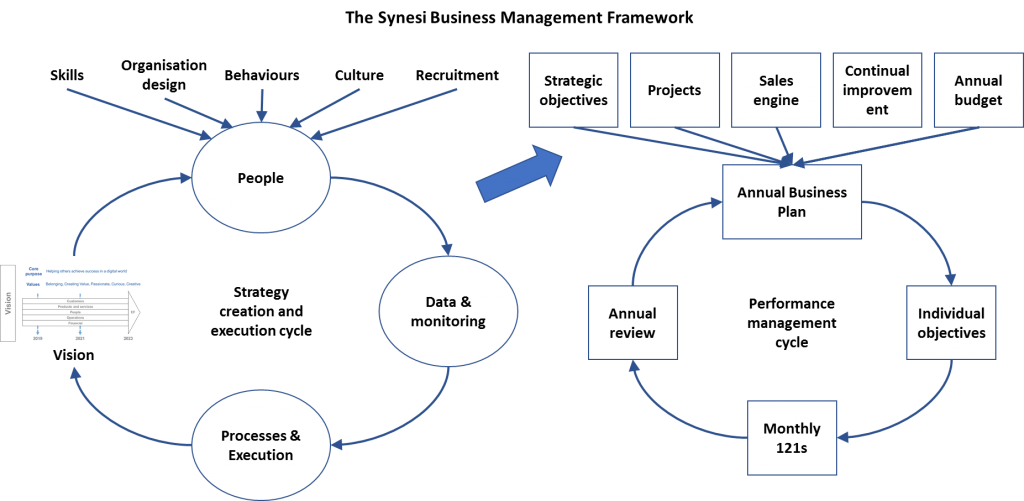
Last time, we showed what a strategic framework for managing a great business looks like. This time, we’ll start to give you a practical guide for you to build a great strategy for your business. In our framework, we’re in the left-most Vision box.
We’ll be describing a Visioning approach to strategy. There are other approaches (we’ll come back to this in a future post), but visioning tends to be a component of all of them. Visioning is about imagining the future that you want to create – think Owen Farrell drawing a line through the posts when he lines up a conversion.
Visioning allows businesses to make transformational change. It’s not about 3% annual growth, or continual improvement, it’s about step-changing what you do.
For us, a Vision consists of 4 core components, which we’ll describe in more detail in this post and the next:
The Core Purpose is the reason why we exist, over and above making money for the shareholders. It’s a destination that we never reach.
The Values show how we will behave, and help staff to make the right decisions.
The Envisioned Future is our ten-year goal.
The BHAGs are the milestones to the Envisioned Future.
You can think of this as a journey, from the Envisioned Future back to us today:
Creating your Core Purpose
A Core Purpose is your North Star, the unifying purpose for the team to get behind. It is never about making money, but about finding a long-term goal that you will never reach but that will inspire your people to do their best work.
Core Purposes are much more discussed now, largely in connection to Millennials wanting to work for businesses with a purpose. But the truth is that almost everyone does; only 20% or so of people are motivated primarily by money. You’ll still sometimes find the old attitude that employees should be grateful for their pay cheque, but we shouldn’t forget that the best employees can choose where they work, and will vote with their feet. And customers can also choose who they buy from…
A Core Purpose is a short statement that should appeal to both head and heart. There’s plenty of examples on the internet; one example that we like is Walt Disney’s ‘To make people happy’. Who wouldn’t want to work for a company that did that…!
One way to think about this is to consider what your company really does. A great example of this is Harley-Davidson. Most people would describe Harley Davidson since the 1930s as a producer of iconic motor bikes.
But this isn’t how they describe themselves. They say: “We fulfil dreams of personal freedom – it’s our purpose, and we take it seriously”. As John Russell, former managing director of Harley-Davidson Europe, once said: “Harley Davidson sells to 43-year-old accountants the ability to dress in leather, ride through small towns and have people be afraid of them.”
Knowing what you really do allows you to see numerous opportunities from a higher, elevated position. True elevation of purpose is what makes businesses sustainable into the future, in the sense they are able to survive and thrive for longer. Such businesses can branch out in directions that are true to themselves but unexpected to their competition. Knowing that Elon Musk’s Core Purpose is Preserving Humanity explains the link running between companies as diverse as Tesla, Space X, The Boring Company and Neuralink.
You can develop a Core Purpose in a group exercise, perhaps with a mix of senior managers and staff representatives, or on your own, especially if you’re the founder of the business. Think about why the business was set up in the first place, the good it brings to customers, society and individuals, and why you keep working for it. We’ve had success by asking people to come up with ideas on their own, and then finding areas of overlap.
But how ever you do it, it is important to trial the Purpose with your key people before launching it to the business, to find out if it works. You know you’ve got it right when you hear them using it unprompted.
Creating your Core Values
Articulating your Values can feel a bit like pinning a beautiful butterfly to a display board – you worry that by writing them down, you might kill something special. But until they are written down, you risk everyone having their own view and interpretation of what they are.
When they are clear to everyone, they can become core principles of behaviour that allow staff to make the right decisions on their own – that’s why they are shown as a compass in our diagram.
Again, it makes sense to find the right group to work these out with, and some businesses even consult their entire workforce. The starting points for agreeing a set of Values are:
The existing (if unwritten) Values of the business; and
The personal values of the group creating them.
There needs to be a strong alignment between personal values and the company Values; if not, this will cause trouble…
There are many ways to arrive at your final choice of Values. We often ask people to come up with their own lists individually, combine them, and then allocate votes to the long list to whittle it down. It’s also a great way for you to learn about your people – what really matters to them? It makes sense to revisit the final result as a group to ensure everyone is happy with the selection and nothing important is missing.
There should also be alignment with the strategic aims of the business (which we will discuss in the next post). For instance, if innovation is core to your business’s future, then values such as Exploring or Curiosity could be prioritised. It’s worth holding Values in draft until you are clearer about where you are going.
Values should be assigned with an order of importance, so that you can resolve conflicts in decision-making, and this order should be communicated. A good mnemonic (remember them?) can often help everyone remember.
A Credo is a short story or summary that brings the Values to life; this can be published to help embed them in the business. Johnson & Johnson have a famous one, which you can find in stone in foyers of their buildings, as well as on their website.
Once you have created your core Purpose and Values, they should never be changed. They become part of the DNA of your business.
Using the Core Purpose and Values
In the future, this topic might get a post of its own. But there are some key points we need to make here.
Firstly, leaders in the business, especially the CEO, need to be role models, living the Values at all times. No one should be above being challenged on their behaviour. Sometimes, this might mean making tough decisions, perhaps losing out on a sale, or parting company with an effective but misbehaving employee. Your people will judge how serious you are about the Values by what you do, not what you say.
Secondly, you should encourage decisions to be made with reference to the Values. When you make a decision, explain how the Values have helped you make it. Let your people know that if they have made a mistake, you will always support them if they have followed the Values; if they haven’t, they’re on their own.
Thirdly, the Values should be used to assess staff, just as much as their achievement of results. To make this less subjective, it can be helpful to define behaviours for each Value. For instance, one client defined Challenge behaviours in their business as: ”I only challenge to make things better” and “When I see something that I don’t think is right, I will raise it in the right way with those around me, irrespective of who they are”. This also helps clarify what is meant by the Values.
Fourthly, you should build Values into your recruitment process. There will be a future post on this.
We’d love to hear about how you have used Values and Purpose in your business. How have you got staff to buy in?
Next up, we will focus on creating your Envisioned Future.
igesia Consulting helps businesses and the people in them to become peak performing. We understand what the very best organisations do, and work with companies like yours to give you the skills, plans and structures to do the same.
















Recent Comments