A couple of posts ago, we talked about creating a Dolphin culture of high challenge, high support. Last post, we considered the elements of a performance management system to sit within our Framework, and the role of Situational Leadership in using the right style to manage people. To bring these elements together, we need to think about one-to-ones.
One-to-ones are monthly meetings between manager and report which are intended to ensure that the report is performing to the top of their ability, developing in a way that works for them and you, and on track to deliver their objectives. In a Dolphin culture, the manager’s role is to challenge the individual, but also to make sure that they have everything they need to deliver. Everyone benefits when this works properly: individuals achieve their objectives and learn new skills; managers see their departments performing; and businesses move faster in the right direction.
Here’s how good one-to-ones work.
Before the meeting
Make it the individual’s task to organise the meeting; after all, they are the owner of their own development. Think of yourself as the coach and them the athlete; it’s your job to make them look good. This approach builds trust between manager and individual, and encourages honesty, especially when you have a genuine desire to help.
A regular monthly slot booked ahead for the year is ideal. An hour should be long enough for most one-to-ones; the exception is if you manage managers, where you should allow 2 hours, so you can also discuss the performance of their reports.
Recent research shows that the amount of time given by managers to their staff is one of the key ways that staff decide if they feel valued or not. Allow an extra half hour in your own diary in case you need to give them more time, and to make notes afterwards.
Preparation makes for better meetings, as do concrete facts. Individuals should send their managers a completed 1-2-1 form at least 24 hours before the meeting. Writing this information down forces them to think properly about it. The form should cover:
Contribution: what have you (the employee) done for us (the business) lately?
Improved capacity: what have you done for yourself lately?
Developmental needs: what are your career aspirations?
They should also attach updated action plans for their objectives.
Effective one-to-ones are built on strong human relationships. Take time to establish such a relationship with everyone who reports to you. This really should go without saying, but we have far too many stories of teams that complain that their managers never say good morning, or who walk past without making eye contact. These are basics; it doesn’t cost money or require any particular skill. You only have a handful of direct reports; you really should know the names of their partners and children.
During the meeting
Avoid talking about today’s issues. One-to-ones are about focusing on delivery of objectives and developing skills. Find another forum to discuss business-as-usual.
Let the individual start the meeting by giving an overview of where they are. We encourage them to talk on the three areas of the 1-2-1 form. As a guide, the individual should be talking for around 80% of the meeting. Be sure to use active listening skills. Find out at if there are any personal issues; these could be the key to understanding performance levels.
Review each objective, spending more time on those with lower D numbers (see situational leadership as discussed last time). Identify both good and bad areas.
Positives
Catch your people doing things right. We thrive on praise and positive feedback, and studies show that ignoring good work can be just as damaging as criticising it.
The trouble is, we don’t value anything that comes too cheaply: a throwaway ‘Well done’ just doesn’t cut it. But if you invest just a little time and effort, the rewards are huge. Follow the PIE outline:
Point out the good work
Identify the specific skill, knowledge or attitude used
Explain why it was important.
As an example, rather than saying “Well done in the customer meeting”, try something like: “I really liked the way you handled the customer’s objection on launch timings. It showed you fully understood the launch process and its implications. As a result, the customer was not only happy with the launch date, but also increased the scale of the launch, boosting our fee.” Which approach would have the greater impact on you?
Don’t forget to consider whether the good things that you caught your people doing could be something that everyone could benefit from: feed the best ideas into the continual improvement of your processes.
Negatives
Identify areas where deadlines and targets are being missed. Even good performers miss targets sometimes; there may be extenuating circumstances. But watch for consistent and widespread target missing. For these areas, make sure you really understand what’s going on first from their perspective. Identify causes, and come up with and document remedial plans; ideally capture actions in the meeting itself.
Remember that some objectives will be developmental for the individual. Think of ways to support their learning. Mentoring and coaching can be effective, but perhaps the most impactful way to develop staff is targeted work assignments; think carefully about what might work best. Make sure you define these objectives carefully, and use Situational Leadership to provide the right support. Training courses are often seen as a first option, but that can just be lazy thinking. Try to use them last…
You will often hear people say that they haven’t had time to deliver a target. This is only rarely true; after all, people spend 40 hours a week or so in work. What they mean is that they deprioritised the objective and did other things instead; this should be a red flag for you. Find out why by using GWC; ask questions in this order:
Get it – do they understand what is required?
Want it – do they actually want to do it, or are there reasons that they don’t want to?
Capability – do they know how to, and do they have sufficient resources to do it? This is often the issue when you have agreed too high a D number.
Make sure you communicate your position on problem areas clearly to the individual – is an issue impacting just their current performance, or might it inhibit future promotion, or might it even be in fact be job threatening?
We have taken straw polls of managers, asking which of them have been guilty of giving poor performers too much time in the business. Nearly all managers confess they have done this. When we ask who feels they have exited people too quickly, we almost never get a reply. Managers hang on to staff too long for many reasons, but rarely for good ones…
One-to-ones are an effective way of managing poor performers out of the business. With black-and-white objectives and timings, there is nowhere to hide, either for them or for you. Yes, we should give everyone a chance to turn their performance around. Yes, we should identify limiting factors, and work with the individual to find ways round them. Yes, we should take extenuating circumstances into account. But if someone is not delivering or behaving in line with the Values, we owe it to the business (and their colleagues who have to compensate) to exit them. Exit them with dignity and fairly, but exit them.
After the meeting
Ensure that key actions are captured in updated action plans, and then shared with the individual. This is especially important if performance is not good; if disciplinary action might be required, then this will form a key part of the evidence. Take notes if appropriate, too.
Conclusion
A key challenge back from both managers and staff is that they say they don’t have time to do their one-to-ones.
It is true that one-to-ones are an investment, but one with a positive return. It actually saves time in the long run, by focusing staff on what really matters, and by freeing managers from having to micro-manage. The conversations in a one-to-one need to happen; this brings structure and accountability. Our experience shows that as everyone starts to use the system, the vast majority see the benefits and don’t want to go back. It is important to train all staff in the approach, especially managers.
When an employee makes the improvements needed, and as a result goes on to win a great promotion or new role, they will remember forever the person who helped them through the process. How great would that feel?
Please let us know about your own successes and failures in developing staff – we’d love to hear from you.
Next week, find out how best practice recruiting will help you find more of the right people and fewer of the wrong ones…
igesia Consulting helps businesses and the people in them to become peak performing. We understand what the very best organisations do, and work with companies like yours to give you the skills, plans and structures to do the same.
You’ve created a winning strategy for your business (see previous posts). You and your management team are excited about it. But how do you ensure that your people deliver it?
Well, we’ve dropped some heavy hints that a strategic performance management system is the key tool that allows you to link your strategic objectives to individual performance, via the annual business plan. Here’s the Framework diagram again to remind you how it all fits together.
A good performance management system delivers many positive business outcomes:
Positive behavioural change across your people.
Increased motivation and effort.
Improved retention and development, especially of key contributors.
Internal promotion and success.
Prevention and protection against legal action.
Unfortunately, many systems are ineffective, because they are trying to do too many things at the same time. They are seeking to improve results, build capabilities and allocate financial reward. As a result, they do nothing well. Our system focuses on capabilities, which will lead to improved business performance. The employee is therefore at the centre of the process: they are the key customer and the owner – they must take responsibility for their own development. And we don’t use this system for reward, or only indirectly.
This post will set out how a good performance management system looks. As we’ve said before, there are other ways of doing it, but this ties in to our overall framework, and (most importantly) it works.
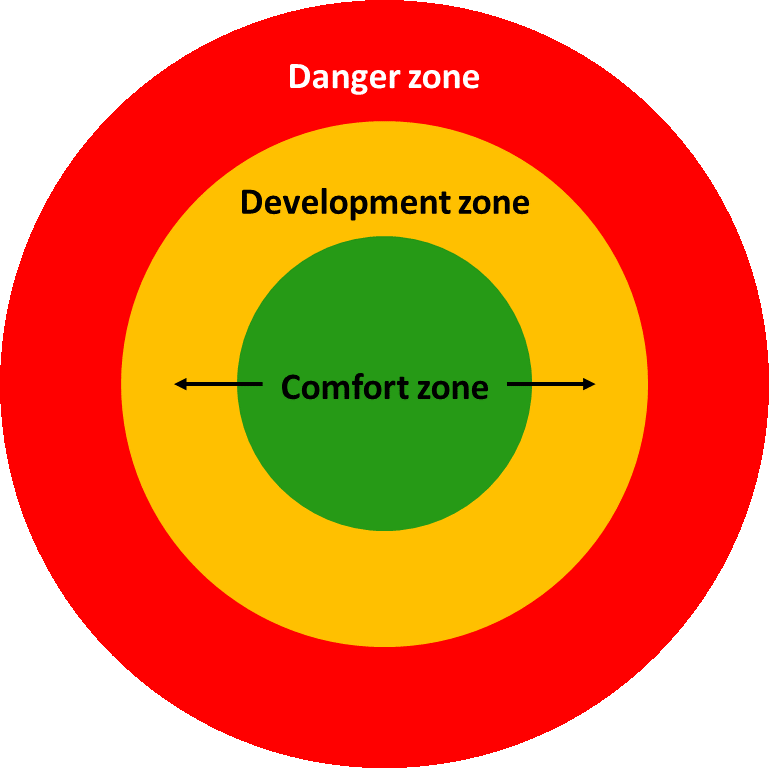
Moving out of the comfort zone
We all have our comfort zone. This is when we do things that we find easy and that cause us no stress. You might find yourself doing something in your comfort zone when you’re tired in the evening.
Taking on something new causes us to move outside our comfort zone. If it’s not too far outside, this is where the magic happens: we can learn and grow in our development zone. Over time, as we develop and learn, our comfort zone expands. But if we have to do something too far outside, our natural stress responses can kick in, and we look to fly or fight rather than learn. This is our danger zone.
The world we live in is changing faster and faster, and we will all find ourselves needing to learn and adapt more than ever. We need to help our people spend more time in the development zone, whilst avoiding the danger zone. Here’s how.
Situational Leadership
The rock that we build our performance management system on is Situational Leadership, as developed by Paul Hersey and Ken Blanchard. It is a tool that all managers will benefit from. For more information, their book ‘Leadership and the One Minute Manager’ is well laid out (and refreshingly brief).
Many managers assume that a ‘good’ employee will perform in all situations, whereas a ‘poor’ one won’t. Hersey and Blanchard pointed out that an employee’s competence and confidence vary according to the task they are set. Even your best employee can fail at a task of which they have no experience.
They went on to say that as an employee spends more time on a task, their levels of competence and confidence change (this is their comfort zone expanding). Managers therefore get the best out of their people when there is a mutual understanding of where the employee is on any given task, and the manager changes their leadership style to suit.
The first step in using the approach is to diagnose where the employee is on a given task. This is best done in discussion with the employee. The diagram below shows how an employee given a new task can feel very confident, although their competence is low: they don’t know what they don’t know.
As they progress, they start to see that the task is bigger and harder than they had imagined, and their confidence can take a knock. Over time, their competence increases, and their confidence recovers. In due course, they become familiar with the task and good at it: their Comfort zone has expanded. And then you give them a new task….
Once the employee’s position has been diagnosed, you as a manager can adopt the right leadership style, as set out in the (similar) diagram below.
With a newbie in D1, you need to adopt an instructional style – show them exactly what to do. In D2, you have already explained it, so it is more about demonstrating than teaching. Non-directive coaching in D3 is classic coaching, where as a manager you try to restrict yourself to only asking questions, to help your employee grasp the answer for themselves. Delegation in D4 is not abandonment; boundaries, expectations and timelines must be established. Your level of contact with the individual will decrease along this journey, and the type of conversation will change.
Managers naturally have a tendency towards one of these styles, and rarely use more than two. But using the wrong one has consequences. Treat all staff as if they are in D1, and they will feel patronised and unvalued. And delegate to the wrong people, and you are raising the chances that they will fail. Make sure you are using the right style.
The employee can disagree with you on where they are. Avoid a battle on this, but let them know that there will be consequences if they fail to deliver. If he thinks he is at a higher D level than you do, he is probably over-rating his competence, so make sure you check his output more often that you would normally. If she gives herself a lower D number, she is likely to be lacking confidence rather than ability. Provide reassurance and time to build confidence.
Adopting situational leadership creates a common language across the business. It also makes it OK for staff to admit that they don’t know how to do something; it’s much easier to say that you are at D1 than that you don’t have a clue. And from an employee point of view, it gives them a tool to push back at micro-managers.
The benefits of this approach should already be clear, but even better is that it integrates into the rest of our framework.
Elements of the system
If Situational Leadership is the foundation, what are the key building blocks of a performance management system?
Objectives
The Annual Business Plan is a pivotal document. Key business objectives, whether strategic, business improvement, budgetary or important projects are the inputs, and the outputs are 10 to 20 items with quarterly targets for the year ahead that we call Rocks. These Rocks are assigned to individuals, typically on the senior management team, and are cascaded down the business as individual objectives. Generally, the CEO’s personal objectives will be almost indistinguishable from those of the business, but that will change at lower levels.
Objectives and the business plan are best documented as action plans, as we discussed last time. Usually, the manager’s Hows will become the Whats of their direct reports. In our experience, you should challenge whether objectives are really a What or are actually a How.
For instance, your Head of Operations would own the production Rocks, and be responsible for delivering them. He would allocate parts of the Rocks to his Factory Manager, who would in turn split them out between his shift managers. These rocks become both departmental targets and individual targets. This process works best collaboratively with all involved.
Everyone should have 5 to 9 objectives in total, in place before the year starts. Each individual will have most of their objectives spinning out of the business plan. But they should also have some developmental objectives which are specific to them. These should flow from a conversation with that individual, and help take their career in the direction that they want. The accountability charts we created in the strategy process are very useful in having these conversations, as are position contracts (to be discussed in a later post). Remedial actions for under-performers can also become objectives. However, nothing else should; if it’s not linked to your business plan or personal development, it’s not important enough to be an objective.
Objectives should be SMART, to make it crystal-clear if an employee has delivered or not. As a reminder, SMART stands for:
Specific
Measurable
Achievable
Relevant
Time-bound
It can be hard sometimes to set measures for behavioural or developmental objectives, but it is usually possible with careful thought. Define the behaviours you want to see, as we suggested when we discussed the Values.
Action plans
Individuals should create Action Plans for each objective, and agree these with their manager. You can add an extra column to the action plan to put in an agreed Situational Leadership D level. This will help you work with the person to better deliver their objectives. Remember, the D level is task specific, so is attached to a How rather than a What. People should have a spread of D levels; too many high ones and they’re not being challenged and will get bored. Too many low ones, and they will spend too long outside their Comfort zone, which is stressful.
One-to-ones
For some tasks where an individual has a low D number, you may want to check in weekly or even daily. But progress against objectives should be discussed at least every 4 to 6 weeks in one-to-ones, and remedial action taken if appropriate. What takes place in these meetings is key to success, so we will spend the next post on how to have effective one-to-ones within our framework.
Annual assessment
At the end of the year, individuals should have a formal Assessment for their progress, both against objectives and their behaviours in line with the values. In a Dolphin culture, the vast majority of staff deliver on both objectives and behaviours.
Conclusion
We can now see the clear line between our strategy and people’s objectives, via the business plan and the rocks. We call this the Golden Thread. It aligns every part of the business, and ensures that all employees have clarity over their role in delivering the future. The process gives staff a better understanding of your strategy, too.
Employees working in your business will be pushed, but will receive the right support; both you and they will achieve more than you might imagine.
In our experience, the best performance management systems contain these core elements, but we are always learning. We’d love to hear what you do that works.
Next time, how to conduct one-to-ones.
igesia Consulting helps businesses and the people in them to become peak performing. We understand what the very best organisations do, and work with companies like yours to give you the skills, plans and structures to do the same.
Creating an exciting strategy is one thing; delivering it is quite another. Our last posts showed you how to build a clear and compelling Vision for your business, starting here. Your new strategy is likely to mean doing different and new things, but there is still a business to run. If you are not careful, you will dust your strategy down in a year’s time, and realise that you have made no progress.
The best companies structure their whole businesses around delivering their strategic goals, because it requires the coordinated effort of everyone. They do this without taking their eye off the day-to-day. How do they do this?
In this post, we will discuss some of the things that you can do to help you execute your strategy without dropping the ball on delivering for your customers and shareholders. These changes are in addition to a strategic performance management process; this is the right-hand side of our Framework diagram below:
A strategic performance management process is arguably the most important process within your business, as it links the business’ strategic and operational objectives to personal ones. It connects a goal that could be ten years away to actions that must be taken today. It is so important that we will devote the next few posts to it. A future article will also discuss how you can communicate your new strategy to your staff.
A culture of Accountability
Creating accountability is vital to executing a strategy. All staff must know what they need to do, and there must be consequences if they don’t do it. This can make many businesses, especially small ones, very uncomfortable, and may require a shift in your culture. For this purpose, culture can be seen across the two dimensions of challenge and support:
The most successful organisations combine a high level of challenge with great support; we call them dolphins, as they act like a dolphin pod, working together for mutual benefit. The New Zealand All Blacks rugby team is a great example of a dolphin culture. These organisations are often the most satisfying places to work, as it is where you can really excel at what you do and see real success.
But many businesses prize friendliness most, and lack challenge and accountability; we call them goldfish, as they are not to be feared. Shark organisations are where only the strong survive; teamwork does not flourish. Think trading floors in the City. The worst organisations have neither challenge nor support; they are spineless jellyfish.
What is your culture like? What is your personal style like? As a leader, you set the tone for the whole organisation. Do you permit lack of delivery? What do you do when someone does not deliver something they committed to – what are the consequences? Do you ever roll up your sleeves and help? Do you set impossible targets? What are the consequences of under-performance?
What actions do you need to take to become more Dolphin? What challenge do you need to give? What support should you be providing? We will discuss culture in much more detail in later posts, but this is something you can start work on right now.
Tools to deliver your strategy
Here are some structural tools that you can put in place to help execute your strategy:
1. Annual Business Plan
An annual business plan combines all the priorities for your business for the year ahead, and allocates them to specific individuals to own and deliver. It includes strategic elements from next year’s BHAGs, as well as more tactical business improvement initiatives, budget targets, sales targets and anything else that must get done. There should be around 20 items on it; any more and they won’t get done. Set them out as an Action Plan (see below).
With this in place, objective setting for staff becomes much simpler. Business plan targets are simply cascaded down through the organisation and allocated out. It can help ownership for members of a department to discuss how their departmental objectives will be shared.
2. Rocks
If you set someone an annual objective, the chances are they will start thinking about it in October, if you’re lucky. So to ensure a constant focus on objectives throughout the year, split your annual objectives into quarterly ones. We call these Rocks. They should lead smoothly towards your end of year goals. You should do this for individual targets when you set them, and for business plan objectives too.
3. Meetings
Meetings aren’t generally popular in businesses, and with good reason; we have all daydreamed our way through countless pointless and ineffective gatherings. However, well-run meetings can be a great way of resolving issues and keeping everyone informed of what’s going on.
Thought should be put into aligning all meetings in the business around the strategic priorities. Ruthlessly review your meetings, and cull any that do not deliver against priorities in the business plan. Key meetings required will probably include:
Annual Strategy Cycle. This is to review and update your Envisioned Future and BHAGs, including setting up next calendar year’s BHAGs to translate into the business plan. Time should be taken to ensure that the EF is still valid, and maximises value creation.
Monthly Meetings. Your leadership team should meet to discuss strategic issues, monitor financial results, resolve outstanding problems and cover any other business.
Weekly Pulse meetings monitor the delivery of Rocks, review your KPIs, create a forum for upward communication and address any issues of the day. Corrective or mitigating actions should be taken, and all actions for the team logged and reviewed. Pulse meetings should cascade down the business, ideally on the same day, so that everyone gets to hear the same news and issues. Feedback should be collected at all levels and fed back up, so this can be a great communication tool. The agenda changes at different levels; it should be more department specific at lower levels, more business-focused at higher ones.
Your cycle of business meetings sets the pace that the business moves at, which is why we call the weekly one a Pulse meeting. In particular, meetings increase accountability, by giving people a deadline by which they have to do their actions or face the challenge of questions from their peers.
There is lots of material on the interweb about what makes a good meeting, and this isn’t the place to go into great detail. However, a few simple rules can make meetings much more effective, and even (whisper it…) fun:
Every meeting should have a stated purpose and an owner
The owner should have a clear agenda sent at least 24 hrs in advance, including timings and a clear description of each item to be discussed and the desired outcome. Any reading material should also be sent in advance.
Attendees should arrive on time and be prepared.
Everyone should have their say on difficult topics, and more junior people should speak first.
All agreed actions should be formally captured, circulated, and reviewed in the next meeting (minutes aren’t generally necessary). See below for what makes a good action plan.
The best teams also have strict rules about how members behave in meetings:
The company’s needs come before personal interest.
Meetings aren’t for theatre, show-boating or demonstrating knowledge or intelligence, they’re to resolve issues.
All members show each other respect and support each other outside the room.
No behind-the-scenes conversations – the discussion takes place in the meeting.
4. Action plans
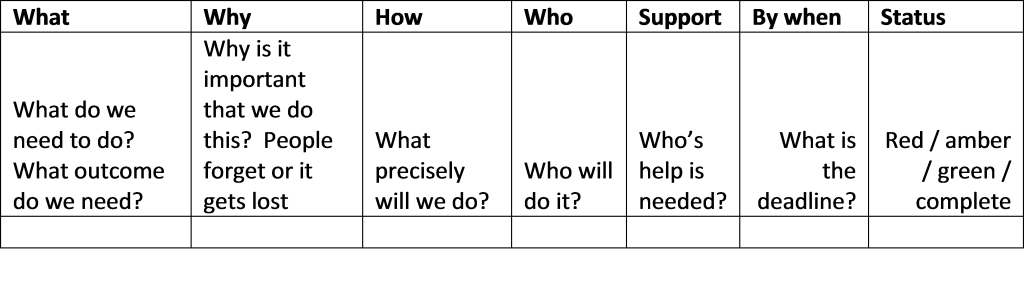
At times, we have all found a stretching target daunting. The solution is to break it down, step by step. The steps should be documented in an action plan; the act of writing something down is psychologically important, and increases our commitment to it. Action plans should also be used to capture all actions coming out of meetings or in the general running of the business.
We have found that the best actions plans looks like this:
You should encourage all staff to create action plans for their objectives.
Conclusion
You can introduce all the best structures in the world and still be a goldfish. Goldfishness can stem from the best intentions (e.g. a desire to protect your staff) or from less good ones (e.g. seeking to avoid confrontation). But if the leaders of a business signal that is OK not to deliver, then that message will be heard loud and clear across the business. Not delivering must have consequences. We’ll talk more about this in due course.
The last half dozen posts have walked you through how to create and execute a strategy. As we promised, there is a lot of work here. And it’s never ending – you repeat each year to make it a core part of how you run your business. But as you take your team through the process, you’ll start to hear the very satisfying clunks and clicks as it all starts to slot together in their minds.
Our next posts will focus on the right-hand side of the framework – how to build a performance management system which will accelerate your business towards its strategic goals.
Please get in touch if you have any questions, comments, success stories, challenges or are just lonely…!
igesia Consulting helps businesses and the people in them to become peak performing. We understand what the very best organisations do, and work with companies like yours to give you the skills, plans and structures to do the same.
Some dogs are completely reliable. They will come up to you, wag their tail and give you a lick every time. Other dogs are less reliable, more unpredictable. They might often wag and lick, but sometimes they might growl at you and occasionally they might even try to bite you. This can be off-putting and even scary. The chances are that you won’t try to stroke that dog again.
Customers’ experiences of businesses can be the same as yours with those dogs. Some businesses always seem to get it right; other will sometimes give you a bad experience. Which businesses would you rather give your business to?
The consistent businesses are almost always the ones with great processes. These are often the most profitable too; after all, poor processes leak both profit and customers. Consistency is one of the foundations of peak-performing organisations: nothing can be fine-tuned until it is consistent. That is why processes take a key role in our strategic Framework.
In this article, we will show you how you can implement great processes across your business, and be like that dog that never bites.
Benefits of having great processes
Your business processes are how your business gets things done. Let’s clarify a little.
steel pipelines and cables in a plant,Industrial zone.
For a process to count as a process, in our world at least, it needs to be written down. If it’s properly documented, then some great things can happen:
The process gets done the same way, over and over. Have you ever discovered that something that you thought was happening in your business (and that was introduced for a really good reason) has been quietly dropped?
The process will continue when people leave – the knowledge becomes the business’, not the individual’s. This will also increase the value of your business if you want to sell.
Training for new starters is easy; they work to the processes.
You can improve it! When you think of a better way of doing it, you can capture it, train it out and it becomes the norm.
You can hold people to account for not doing it properly.
Many businesses have documented processes. Heavily regulated industries require them, such as aerospace, pharmaceuticals or financial services; ISO accreditation does too. But typically, these are operational processes that only cover a fraction of all the processes in a business. Very few businesses document their sales process, or their accounting processes, for instance. And when we talk about processes, we mean all the key ones. Luckily, the 80 / 20 rule applies: 20% of your processes will deliver 80% of the results.
We like to talk about XOX processes. An XOX process is an eXtraordinary process which allows Ordinary people to achieve eXtraordinary results. Most processes are OXO… This post will allow you to create XOX processes in your business, and to see the rewards.
Hallmarks of great processes
In peak performing organisations, Purpose, People, Products and Process must align to achieve sustainable success. In other words, every single element of the structure needs to be integrated with every other element – one of the reasons why we follow our Framework.
Some of the attributes of great processes are:
Porous and permeable. Information should be able to flow into, through and out of the systems, and allow for collaboration and exchange of ideas. Great data can lead to analysis and insights, which helps with ongoing improvement and also feeds the step-change improvements coming out of your strategy.
Pace. Many processes are designed (or seem to be) for compliance reasons. A truly great process will also work quickly, speeding up delivery for the customer and reducing costs for the business.
Responsiveness. Processes need to be able to respond to both internal and external inputs, triggering behaviour, actions and new thinking.
Creating XOX processes
Creating XOX processes is not something that people typically enjoy (though there are a few who do!). However, good processes are key to any business, allowing results to be delivered reliably, to time, to quality and to cost. By reducing time and fire-fighting, capacity is created to deliver the strategy. The very best processes are easier to follow than not to follow; automation can help here. The steps to follow are:
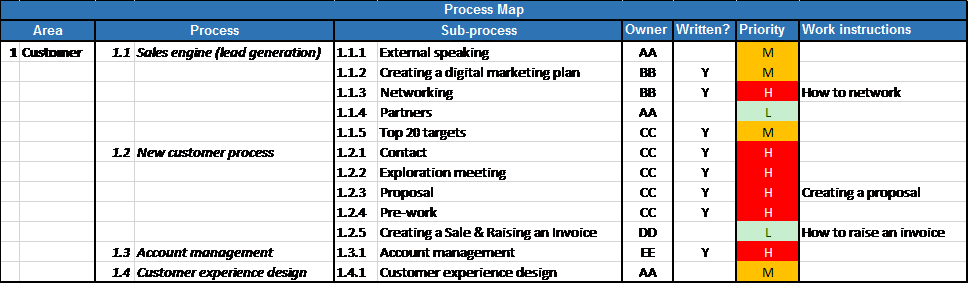
Identify. Identify the core processes in the business, focusing on the 20%. What are the key things that your business needs to do? Think about sales and marketing, customer retention, HR, and finance as well as operations. All areas of the business have processes, but they are often unwritten. For example, how do we win new business? How do we introduce new staff to the business? It can be useful to have a central chart of processes, with each one named and numbered. All processes will map onto the 5 business areas of Customer, Products and Services, People, Operations and Finance. Don’t forget a strategy process (as we have been outlining) and a performance management process (more in a couple of posts time on this)…
You will find that there are different levels of process within your business. Broadly, they should fall into Process, Sub-process and Work Instruction. For instance, you might have an overall New Customer Process, with sub-processes within it of Initial Contact, Exploration Meeting, Proposal and Business Won. You might have work instructions: much more detailed how-to documents, for Creating a Proposal, or Setting up Invoicing.
Assign. Decide who owns each of your key processes – assign to roles rather than named individuals. Ensure that managers know which processes they own, and that they are responsible for improving and updating them. This is critical! It should be captured in every manager’s job description or position contract.
Document. Task the owner with documenting their processes. Start as they are currently, step by step, but log any ideas for improvement. Determine (again by role) owners of each individual step. Documentation should not be too prescriptive; you should aim for 1 page of A4 for each process, although there may be supporting documentation attached to it, e.g. templates or checklists. For many processes, visual aids work well. Flow charts, swim lanes, screen shots or photos could all be included. Identify each process with its number, owner, version number, date last updated and due date for next review. In our experience, managers will put this documentation step off, so holding facilitated meetings or workshops can speed this part up.
Package. Create one document with all your processes, and give it a name, like The [Company name] Way. Ensure it is visible; put it on your intranet or noticeboards.
Improve. Review and improve in line with your BHAGs and EF, e.g. if customer intimacy is key to your strategy, the customer processes must be aligned with that. Indicate what you will start and stop doing, and identify the associated material (presentations, equipment etc) that you need to make the process work. Ensure that the process is easy to follow. What steps could be automated? It is a good idea to involve the team which operates the process in this step. Find out how other businesses do this. Send the team to your customers and suppliers to learn from them. You will be surprised just how happy the best businesses are to share what they do. Think about which processes need to be fast and agile to react to the market, and which need to be stable, perhaps more focused on compliance.
Follow. Ensure that all staff, especially new staff, involved in the process are trained in it and follow it, and know where to find the latest copy of it. Ensure they understand the importance of following the processes. What are the sanctions for not following a process? Ensure that all leaders act as role models with processes; this is where processes often fall down.
Maintain. Set annual objectives for all managers to continually improve their processes. The objectives should include more than one key metric for each process. This could be a Right First Time measure, or a time from start to finish, or a cost. This should be improved year on year. These objectives should align with your BHAGs and EF – more on how to do this at a later stage.
Conclusion
We can become quite evangelical about XOX processes. When processes are improved, it is usual to see multiple benefits. Generally, a better process will be quicker AND lower cost AND produce higher quality results. Great processes are also one of the best ways to ensure that your customers stay with you. Your account management process will ensure that you treat them well, and your operational processes will give them a seamless result every time. You have become a dog that doesn’t bite.
Let us know what you have done to improve your processes. What impact has it had?
Next time, we will look at how you can change the dynamics of your business to help deliver your strategy.
igesia Consulting helps businesses and the people in them to become peak performing. We understand what the very best organisations do, and work with companies like yours to give you the skills, plans and structures to do the same.














Recent Comments