
What Aristotle can teach us about communicating in a crisis

Introduction
The challenges and the amount of change created by the Covid crisis have made leadership more important than ever. People naturally look to their leaders in times like these, wanting to be reassured that someone is in control and has a plan. One of the key roles of the leader is to sell the plan, both internally and externally.
Communication skills are usually one of the first things that you see in a job spec for a CEO, and it is without doubt one of the key skills that a good business leader needs. But what does communication in a business context actually mean, and how can you improve your communication skills?
Communication has been defined as:
“the imparting or exchanging of information by speaking, writing, or using some other medium”.
We realise that we can’t hope to fully cover such a big topic justice in a 2,000 word article. But we can focus on some tools that will provide practical help, both at the moment but also when we reach a new normal, and will also mesh into our Framework. As with everything we do, these tools also work on their own, helping you become a better business leader.

Before we start, we should remember that communication is a two-way process, especially for the type of curious self-aware leader that we have talked about previously. When staff say that they don’t feel communicated with, as often as not it’s because they don’t feel listened to, not because they haven’t been told anything. This article focuses on how you get your message across, but don’t forget the old advice about having one mouth but two ears…
A little theory
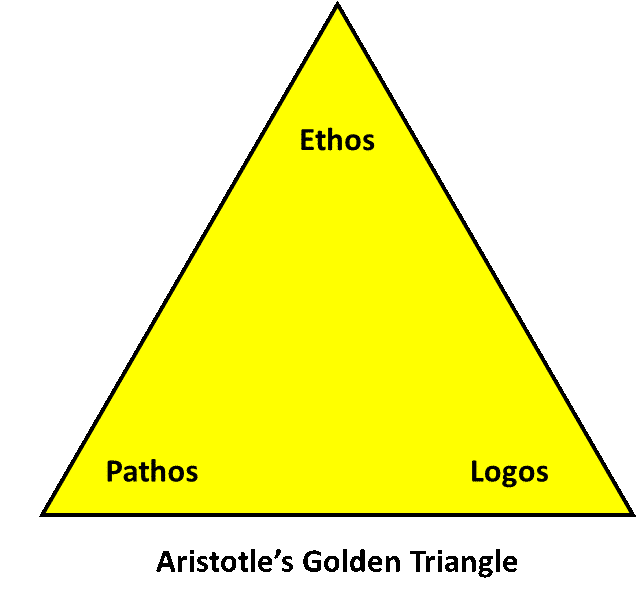
Aristotle was the first thinker to take communication seriously. He first talked about the Golden Triangle nearly 2 and a half millennia ago, but it holds as true now as it did then. The Golden Triangle explains how a speaker makes an impact, and it is comprised of:
- Ethos: the character and credibility of the speaker
- Logos: the proof (or apparent proof) presented by the speaker
- Pathos: the emotional appeal of the argument and of the listeners
Aristotle and others were concerned that Pathos was so much more powerful than Logos, allowing unscrupulous leaders to manipulate those around them. We’ll leave it to others to draw any similarities between ancient Athens and today… But it’s true that we remember much more about how someone made us feel than what they actually said.
There’s a couple of key implications of this. Firstly, even for business leaders, it’s important to ensure that your message includes an emotional element: this is one reason why we think Purpose is so important. Secondly, distil the substance of what you are trying to say to just a few key points (ideally three), and then repeat them as often as you can.
It’s also worth pointing out that Aristotle dwelt on the character of the speaker; the Greek ‘ethos’ is where the English word ‘Ethics’ derived from. We have discussed Values and Core Purpose, both personal and business, at some length. It is clear that when we trust a speaker, we listen to them in a very different frame of mind, and we are much more likely to accept what they say.
Create a plan
Great communication starts with a plan. For any given topic that you want to communicate, such as your strategy to win in the post-Covid world, you can map your stakeholders – the people who may be interested in knowing more about it. Consider how much power they have over you, and their level of interest in your topic, and plot them onto the grid:

Identify your stakeholders carefully and make sure you drill deep enough. For instance, you are unlikely to have just one group called ‘Employees’; you will probably find the needs of managers are different to non-managers.
Once identified, you can create a plan:

Run through your list of stakeholders and think about what they might be interested in or need to know. If in doubt, ask them.
Structured communication
You generally need the most communication with your staff. Setting up clear structures to allow this to happen is critical. We have already discussed some of these. Weekly Pulse meetings are designed specifically to allow two-way communication. The performance management system allows tailored one to one communication.
Think about the tools and channels you can communicate through, clearly more limited at the moment than in usual times. Key individuals may need one-to-one time with you; others may be happy in groups with other managers. It’s very hard to over-communicate, so don’t worry about that.

For when things settle down, think about structures for other stakeholders; you will probably have some already. These might include AGMs, supplier days, quarterly account review meetings, etc.. What else might work? The benefit of having these regular structures is that they can be put in the diary, increasing the chances of them happening. And you are in control; you can plan your message and delivery.
The four-part story
Much of your structured communication will be in the form of formal presentations. We have all sat through far too many poor presentations, ones which leave you wondering what point the speaker is trying to make. The best presenters follow a pattern.
The four-part story is a way of structuring your thoughts and material to ensure that your ideas are transmitted clearly and powerfully; it has been used by everyone from Plato to McKinsey. It is particularly useful when you are wanting to identify and solve a problem for your audience. It can be used for written material (such as articles on communication…) or presentations. The four parts are:
- Situation. What is the background to the issue? It should consist of facts that everyone can agree to – get them used to nodding.
- Complication. There is always a ‘but’, otherwise there would be no need to give a presentation. What is the problem, challenge or possibly opportunity that has changed the status quo and needs to be considered?
- Question. The question is the key issue that you will address, the problem statement to be resolved. It should flow from the complication. You can have just one or several questions.
- Answer. This is the bulk of your presentation (at least 70%), and should logically answer the question.
In many ways, ensuring that the question is the right one is the most important part of the whole structure. Don’t just jump to the first question you think of. Generate a number of questions, and consider which really addresses the heart of the issue at hand. Take as much time as you need to work this out.
You don’t have to show the four-part structure to your audience, but it’s almost always desirable to show some kind of a structure, to avoid them losing the train of your argument.
“But wait”, we hear you cry, “You have just told us that Pathos is more powerful than Logos. Where is the Pathos in your four-part story?” Well done for paying attention!
The four-part structure can be used for highly logical presentations or for more emotive ones. We would suggest that as CEOs, you should always have sound logical reasons for what you are doing, and you should be able to explain them clearly. But you will often want more from your audience – you will want them to buy into your ideas, get excited by them and take action as a result. These presentations we call Leadership Presentations.

What differentiates a Leadership presentation from a ‘normal’ one is the level of Pathos involved. Here are some dos and don’ts for generating Pathos:
- Be clear about what you want your audience to think and feel and do at the end. Make sure that your speech delivers this.
- Put as much energy in as you can. However much you think you are putting in, double it and it still won’t be enough.
- Don’t fill slides with words. Use as few words as you can and as many pictures. Pictures are worth 1,000 words, and create emotional associations.
- Don’t read slides out or read from a script. Reading produces unnatural inflections and is hard to listen to. Know your material and speak naturally.
- Break up your presentation with other material (e.g. videos).
- Be you – share something of yourself, such as personal stories and anecdotes. How do you feel about the issue?
- Practise makes perfect.
- Make eye contact with your audience.
- Project positive emotions – confidence, happiness, humour.
Non-structured communication
The vast majority of your communication is likely to be unstructured. We talked about how as CEO, the rest of [the business scrutinises] your every word and action. How you speak to someone, or even the look on your face as you walk into a room, ripples messages across the organisation.

In essence, you should consider your time at work as being on show. This is one reason why we talk about authentic leadership – if you are spending all that time trying to be someone that you are not, it is exhausting. Here are some pointers to help you send the right messages:
- Treat everyone as a human being. Ask some personal questions. Next time you see that person, ask about one of those details. “How did your daughter’s exams go?”. “How was your knee operation?”
- Mind your body language. Most of our communication is without words. Project confidence, even if you don’t feel it.
- Be the same person all the time. You might be stressed or annoyed, but it’s not the fault of the next person you see. Control your emotions.
- Get out and about in the organisation. Talk to anyone you see. Get your coffee from the machine yourself, and have a conversation on the way back.
Note that these aren’t business messages – they are about you. But always have your three key business points to hand as well, and work them into your conversation. Answer any business questions truthfully, and don’t hide bad news. But always give a positive side. “Yes, last month’s sales were pretty bad, but we are already ahead this month.” Don’t talk like a politician!
This communication is very important for staff morale. Some of you will be introverts and will hate doing it. We are all capable of massive change: find the right support and get on with it!
Selling change
People often fear change. They worry that there won’t be a place for them in the new world, or that they won’t have the right skills and capabilities to thrive. For people to want change, it’s necessary to both pull and push them.

We do this be showing them that the future is a more attractive place than the present. In normal times, it can be hard to show the shortcomings of the present and it requires careful thought. At the moment, that may well not be the case: the implications of doing nothing may be worryingly clear. Painting a compelling picture of the future is perhaps harder in these difficult times, with so much uncertainty in so many areas. But most people will want to believe that there is a positive future.
The majority of your employees are genuinely interested in your plans, but don’t assume that your people share your excitement: the vast majority will be wondering WIIFM – what’s in it for me.
If you are not explicit about this, you will create fear rather than excitement. People will worry for their jobs, as well as the culture of the business. Howsoever you choose to deliver your strategy, make sure that you follow it up with WIIFM. In normal times, you might have workshops by departments in which teams figure out what the strategy means for them and new individual objectives are set. Now, you could have individual Zoom conversations between managers and their direct reports.
Summarise your strategy into something easy to remember, and keep talking about it and repeating the same message. And don’t forget to report regularly on how you are doing, the progress you are making against the strategy.
Conclusion
Communication is a key part of your role as CEO, and is vital to align everyone behind your plans. In an absence of communication, the rumour mill will fill the void; it’s always a good idea to say something even about very tricky issues.
We’d love to hear more about your communication structures and successes. Leave a comment!
Next week, we will be discussing a particular facet of communication – how to talk about difficult topics.
igesia Consulting helps businesses and the people in them to become peak performing. We understand what the very best organisations do, and work with companies like yours to give you the skills, plans and structures to do the same.
Recent Comments