
What the Wright brothers can teach us on building smarter teams to solve the hardest problems

Introduction
The world is changing faster than ever. We said this to ourselves all the time, even before Covid-19, especially when a new piece of technology come out that left us open-mouthed, but it is now truer than ever. The pandemic will accelerate some existing trends and create new ones that no one could have predicted.
And just as the world is changing, so are we, to a greater or lesser extent. We take things for granted that just a few years ago seemed extraordinary. Can you remember the first iPhones in 2007? Suddenly, you could access the internet whilst sat in the pub, or stood beside a sports field. You didn’t care that it was slow and coverage was patchy. Now, we are outraged when we can’t get online wherever and whenever we want to.
The smartphone is a great example of an enabling technology; a breakthrough that makes other steps forward possible. Smartphones have made satnavs obsolete, encouraged people to date with just a swipe and powered Pokemon Go. Companies have now adapted their business models to accommodate smartphones, even if it just adapting their websites to be portrait rather than landscape.
Similarly, the incipient autonomous vehicle revolution has been enabled by electric car technology (itself enabled by improved batteries) coupled with Artificial Intelligence and the Internet of Things.
This constant recombination of technology is what drives the ever-increasing speed of change; it is a true exponential increase. Plotting the top 50 inventions by century illustrates this; 60% of the top inventions came from the last two centuries. Key inventions of the 19th century, such as electricity and the telephone, enabled breakthroughs in the 20th, such as transistor, which enabled the PC, which in turn enabled the internet.

The problem with rapid change
Exponential change creates a challenge for us and for the businesses that we run. We can only cope and react to a certain amount of change. Our ancestors evolved in a world that was essentially unchanged from our births to our deaths. But just look back at the technical leaps that have occurred in your own lifetime. And if you think that you have adapted to all of it, then just spend some time with someone below the age of 15…
Our instinct when we see problems is to apply our previous experience to solving them. We tend to do this very quickly, often at a subconscious level. But the faster things are changing, the less likely this is to work out well. We don’t take the time to ask what is different, what has changed.
This is especially true for business leaders. We feel that we should have all the answers. The truth is, it’s now hard to even be sure what the questions are.
We believe that the businesses that will thrive in the future are those that shift the burden of understanding and reacting to change from the individual to the group. Changing how we work to harness the power of our combined intelligence will allow us to keep up with change – for a while at least.
In this article, we will set out what we mean by this, and suggest some things that you can do that will help your business find better answers to questions both old and new.
But first, a case study to illustrate our point, looking at how Top Invention No. 15 came about.
Samuel Pierpont Langley versus the Wright Brothers

The Langley Aerodrome 6, moments after launch and seconds before impact, October 1903
Samuel Pierpont Langley was an eminent American physicist. He had made some of the first studies of the sun, and had helped ensure that the vast United States ran on a consistent time. So when he decided to crack the problem of manned powered flight in the late 1880s, there was huge public interest and large sums in government spending ($50,000, equivalent to $14m today). As secretary of the Smithsonian Institution (which added a further $20,000), he had unlimited access to skilled craftsmen and instrument makers. In May 1896, in front of the assembled press, his unmanned Model 5 Aerodrome, powered by a small steam engine, flew 700 meters, further than any other aeroplane to that time.
The Wright brothers, Orville and Wilbur, neither of whom qualified from school, ran a bicycle shop in Dayton, Ohio. They developed an interest in manned flight in 1896, inspired by both Langley’s success and the death of Otto Lilienthal, a German pioneer of flight. They experimented with gliders first, before adding an engine. Funding came from profits of the bike shop, and it has been calculated that the cost of the Wright Flyer was less than $1,000 (around $0.25m in today’s money).
Both Langley and the Wrights wanted to crack manned flight, but as you know, and against all the apparent odds, the Wrights succeeded in 1903. Langley had given up a couple of months earlier after his manned craft had crashed twice in the Potomac river in front of the world’s press, with the pilot only narrowly escaping with his life.
Which leads us to ask: why didn’t the better funded, resourced and educated team win? The answer lies in the way that the Wrights worked and thought together.
How the Wrights worked
The Wrights assumed that they knew nothing. Although they carefully reviewed all previous work, they took none of it for granted. When their calculations for lift didn’t tally with their results, they challenged published data, and ran experiments which proved that the generally accepted ‘Smeaton’ coefficient of air pressure was wrong. Similarly, conventional wisdom held that the two problems of flight were wings and engines; the Wrights added control to that list, which was arguably their decisive step.
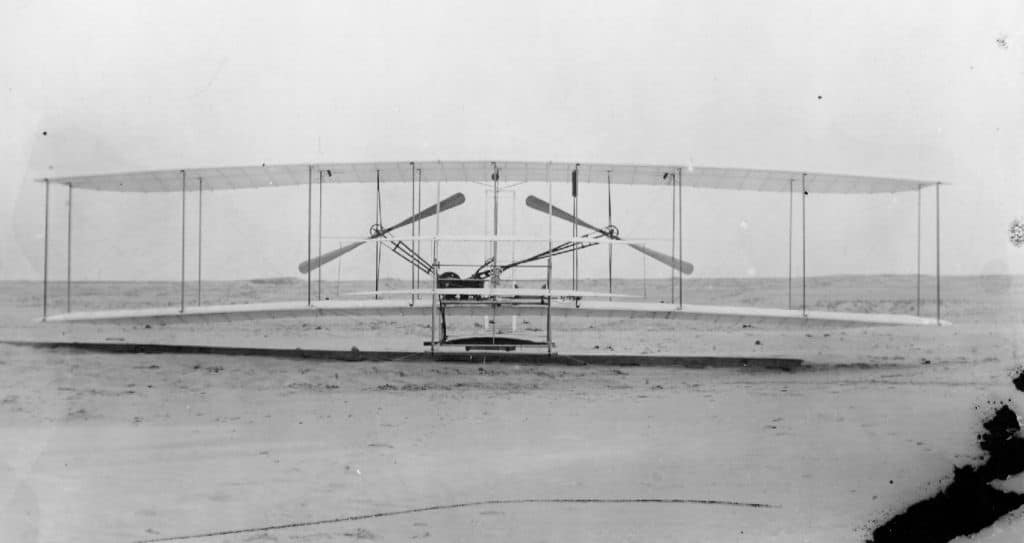
The Wright Flyer at Kittyhawk Sands, December 1903
When they hit a problem, they discussed the issue deeply, often in passionate arguments that went on early into the small hours. Their sister Katherine, overlooked by history, acted as a facilitator in these discussions, and she would make sure that they all knew what had been decided and what the next steps would be. But they weren’t arguing against each other. They were arguing against ideas. And there were times when after many hours, they were as far apart as ever – but each had adopted the other’s original position.
They were honest when they didn’t know something, and they didn’t make assumptions. They tested 200 wing designs in their home-made wind tunnel before finalising their choice. When it came to a propeller design, they discovered that there was no published science on the subject, even on marine propellers. They realised that a propeller was just a rotating wing or two, leading them to set out on another test programme to find the best layout.
When the Wright Flyer took off for its three second flight on December 14th 1903, it wasn’t the result of a moment of genius. It was the culmination of thousands of discussions, ideas, false steps, experiments and insights, driven by the passion and remarkable working methods of the Wrights. Together, they changed the world, in a way that would have been impossible for either of them on their own.
Collective intelligence
This phenomenon of better ideas and thinking emerging from groups is known as collective intelligence. One well known example of this is the ‘wisdom of crowds’ where the average of many people’s views can give highly accurate results; financial markets are a good example of this.

But true collective intelligence can go much further. Manned flight was a hugely complex (and potentially dangerous) set of problems to solve almost from scratch; many elements (such as wing shape, control systems, propellers and engines) had to come together at the same time or it just wouldn’t work. Collective intelligence can help make sense of complexity, and find better and more original solutions. A team with real collective intelligence will create better outcomes than any of its members could have done on their own.
In practice
How can you improve the collective intelligence of teams in your business? Here are some ideas:
- Build diversity in the team in terms of thinking styles, perspectives and knowledge. Look for people from right across your business.
- Ensure that members have higher than average levels of empathy and emotional sensitivity.
- Ensure communication levels are high and that all communication is open; this is a feature of high-performing teams. Technology can help here, especially when the team is geographically spread.
- Include plenty of women, to help with 1), 2) and 3).
- Set clear ground rules for behaviours (see our article on building teams). It is important to create a culture in which everyone has an equal say. Avoid ego, personal agendas and talking to show cleverness. Build on ideas, don’t knock them down (‘yes, and…’, not ‘yes, but…’).
- Argue at the level of ideas, not the people who have them. Argue to discover the truth, not to decide who is right.
- Be willing to challenge everyone and be open to challenge.
- Be curious; assume everything you know is wrong. Seek out the truth.
- Use tools and structures as we discussed previously, such the EDIT model (also called double diamond problem solving), 6 Thinking Hats, double loop learning and premortems.
- Explore the elephants in the room, as we discussed last time. Clearly state assumptions and starting positions.
It is usually better to appoint a facilitator to move the conversation along, rather than a leader to whom people will naturally defer.
Trust is often seen as a prerequisite for the good functioning of teams. Just a word of caution on this: trust is not enough for a high-performing team. The desire to build trust can prevent us from challenging each other, and so get in the way of breakthrough thinking. Respect for each other, a willingness to listen and build, and clear and open communication are arguably more important.
Conclusion
The kind of behaviours we described above are not consistent with the command and control structures still found in so many businesses. In a way, this is the culmination of one of our key themes; that in the 21st century, the winners will be those businesses with empowered, engaged employees. They are able to see change as an opportunity, not a threat, and move quickly to take advantage.
When we discussed conversational capacity, we likened it to a verbal martial art where the enemy is ourselves. Similarly, collective intelligence requires us to hand in our egos at the door. But when we find the sweet spot, we can create things that we never would have imagined.
Let us know what you think, about this or any of the topics we write about.
Next week, how to use different strategic approaches, and the impact they have on your ideal culture.
igesia Consulting helps businesses and the people in them to become peak performing. We understand what the very best organisations do, and work with companies like yours to give you the skills, plans and structures to do the same.
Recent Comments