
How to ensure your business delivers reliably every time

Introduction
Some dogs are completely reliable. They will come up to you, wag their tail and give you a lick every time. Other dogs are less reliable, more unpredictable. They might often wag and lick, but sometimes they might growl at you and occasionally they might even try to bite you. This can be off-putting and even scary. The chances are that you won’t try to stroke that dog again.
Customers’ experiences of businesses can be the same as yours with those dogs. Some businesses always seem to get it right; other will sometimes give you a bad experience. Which businesses would you rather give your business to?
The consistent businesses are almost always the ones with great processes. These are often the most profitable too; after all, poor processes leak both profit and customers. Consistency is one of the foundations of peak-performing organisations: nothing can be fine-tuned until it is consistent. That is why processes take a key role in our strategic Framework.
In this article, we will show you how you can implement great processes across your business, and be like that dog that never bites.
Benefits of having great processes
Your business processes are how your business gets things done. Let’s clarify a little.

For a process to count as a process, in our world at least, it needs to be written down. If it’s properly documented, then some great things can happen:
- The process gets done the same way, over and over. Have you ever discovered that something that you thought was happening in your business (and that was introduced for a really good reason) has been quietly dropped?
- The process will continue when people leave – the knowledge becomes the business’, not the individual’s. This will also increase the value of your business if you want to sell.
- Training for new starters is easy; they work to the processes.
- You can improve it! When you think of a better way of doing it, you can capture it, train it out and it becomes the norm.
- You can hold people to account for not doing it properly.
Many businesses have documented processes. Heavily regulated industries require them, such as aerospace, pharmaceuticals or financial services; ISO accreditation does too. But typically, these are operational processes that only cover a fraction of all the processes in a business. Very few businesses document their sales process, or their accounting processes, for instance. And when we talk about processes, we mean all the key ones. Luckily, the 80 / 20 rule applies: 20% of your processes will deliver 80% of the results.
We like to talk about XOX processes. An XOX process is an eXtraordinary process which allows Ordinary people to achieve eXtraordinary results. Most processes are OXO… This post will allow you to create XOX processes in your business, and to see the rewards.

Hallmarks of great processes
In peak performing organisations, Purpose, People, Products and Process must align to achieve sustainable success. In other words, every single element of the structure needs to be integrated with every other element – one of the reasons why we follow our Framework.
Some of the attributes of great processes are:
- Porous and permeable. Information should be able to flow into, through and out of the systems, and allow for collaboration and exchange of ideas. Great data can lead to analysis and insights, which helps with ongoing improvement and also feeds the step-change improvements coming out of your strategy.
- Pace. Many processes are designed (or seem to be) for compliance reasons. A truly great process will also work quickly, speeding up delivery for the customer and reducing costs for the business.
- Responsiveness. Processes need to be able to respond to both internal and external inputs, triggering behaviour, actions and new thinking.
Creating XOX processes
Creating XOX processes is not something that people typically enjoy (though there are a few who do!). However, good processes are key to any business, allowing results to be delivered reliably, to time, to quality and to cost. By reducing time and fire-fighting, capacity is created to deliver the strategy. The very best processes are easier to follow than not to follow; automation can help here. The steps to follow are:
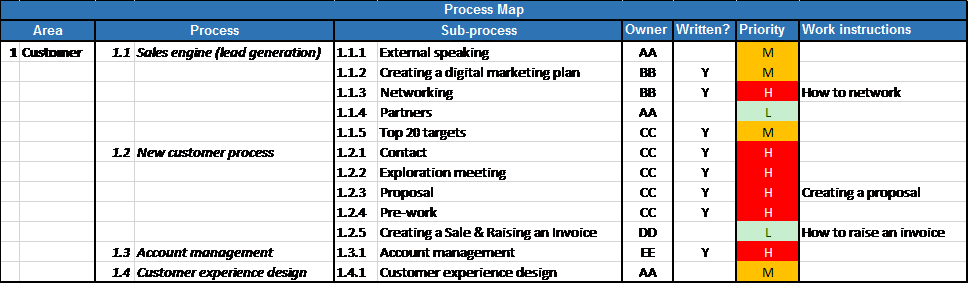
- Identify. Identify the core processes in the business, focusing on the 20%. What are the key things that your business needs to do? Think about sales and marketing, customer retention, HR, and finance as well as operations. All areas of the business have processes, but they are often unwritten. For example, how do we win new business? How do we introduce new staff to the business? It can be useful to have a central chart of processes, with each one named and numbered. All processes will map onto the 5 business areas of Customer, Products and Services, People, Operations and Finance. Don’t forget a strategy process (as we have been outlining) and a performance management process (more in a couple of posts time on this)…
You will find that there are different levels of process within your business. Broadly, they should fall into Process, Sub-process and Work Instruction. For instance, you might have an overall New Customer Process, with sub-processes within it of Initial Contact, Exploration Meeting, Proposal and Business Won. You might have work instructions: much more detailed how-to documents, for Creating a Proposal, or Setting up Invoicing.
- Assign. Decide who owns each of your key processes – assign to roles rather than named individuals. Ensure that managers know which processes they own, and that they are responsible for improving and updating them. This is critical! It should be captured in every manager’s job description or position contract.
- Document. Task the owner with documenting their processes. Start as they are currently, step by step, but log any ideas for improvement. Determine (again by role) owners of each individual step. Documentation should not be too prescriptive; you should aim for 1 page of A4 for each process, although there may be supporting documentation attached to it, e.g. templates or checklists. For many processes, visual aids work well. Flow charts, swim lanes, screen shots or photos could all be included. Identify each process with its number, owner, version number, date last updated and due date for next review. In our experience, managers will put this documentation step off, so holding facilitated meetings or workshops can speed this part up.
- Package. Create one document with all your processes, and give it a name, like The [Company name] Way. Ensure it is visible; put it on your intranet or noticeboards.
- Improve. Review and improve in line with your BHAGs and EF, e.g. if customer intimacy is key to your strategy, the customer processes must be aligned with that. Indicate what you will start and stop doing, and identify the associated material (presentations, equipment etc) that you need to make the process work. Ensure that the process is easy to follow. What steps could be automated? It is a good idea to involve the team which operates the process in this step. Find out how other businesses do this. Send the team to your customers and suppliers to learn from them. You will be surprised just how happy the best businesses are to share what they do. Think about which processes need to be fast and agile to react to the market, and which need to be stable, perhaps more focused on compliance.
- Follow. Ensure that all staff, especially new staff, involved in the process are trained in it and follow it, and know where to find the latest copy of it. Ensure they understand the importance of following the processes. What are the sanctions for not following a process? Ensure that all leaders act as role models with processes; this is where processes often fall down.
- Maintain. Set annual objectives for all managers to continually improve their processes. The objectives should include more than one key metric for each process. This could be a Right First Time measure, or a time from start to finish, or a cost. This should be improved year on year. These objectives should align with your BHAGs and EF – more on how to do this at a later stage.

Conclusion
We can become quite evangelical about XOX processes. When processes are improved, it is usual to see multiple benefits. Generally, a better process will be quicker AND lower cost AND produce higher quality results. Great processes are also one of the best ways to ensure that your customers stay with you. Your account management process will ensure that you treat them well, and your operational processes will give them a seamless result every time. You have become a dog that doesn’t bite.
Let us know what you have done to improve your processes. What impact has it had?
Next time, we will look at how you can change the dynamics of your business to help deliver your strategy.
igesia Consulting helps businesses and the people in them to become peak performing. We understand what the very best organisations do, and work with companies like yours to give you the skills, plans and structures to do the same.
Recent Comments